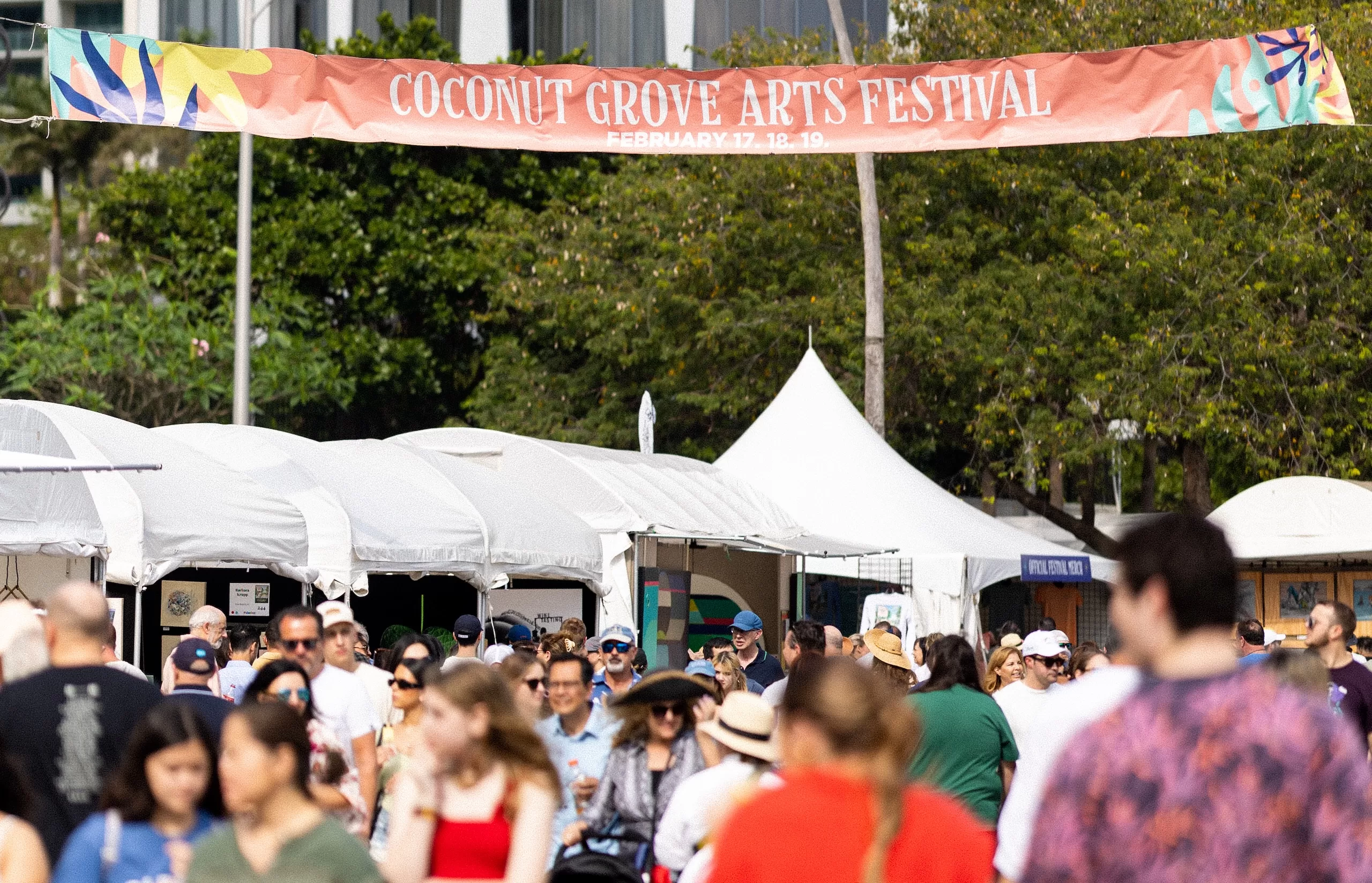
The 1963 brief
Charlie Cinnamon asked a handful of Coconut Grove locals to recreate an outdoor Parisian exhibition. The festival's history page records the purpose: publicity for the Coconut Grove Playhouse production of Irma la Douce. Cinnamon moved from New York to Miami in the late 1950s.
The same page credits a visit to the Playhouse with starting his path into Miami's arts world. The clothesline arts fair he staged on the pavement outlasted the production it promoted.
The association numbers the 2027 edition the 63rd, and it opens on 13 February.
What 63 editions prove
The production the fair publicised belongs to a 1963 season. The fair still runs. A publicity device became an institution that funds arts programmes all year.
The association describes the festival as one of the largest outdoor arts festivals in the nation. It draws tens of thousands of people to the Grove each Presidents Day weekend.
That is the case for the streets. The return behind it is auditable.
A city lends pavement to a nonprofit for a weekend. The return a city can check is the money the weekend leaves in programmes it can name. This association publishes that return at line level.
The ledger
The Coconut Grove Arts and Historical Association produces the festival, and it holds 501(c)(3) status. Everything the weekend earns goes back into its year-round arts programming.
A budget line of $75,000 a year pays 15 graduating seniors from local public magnet arts high schools. The scholarship programme marked its 28th anniversary last year.
Florida International University splits $30,000 a year across 10 students, in a programme that runs through the 2026 academic year and carries $90,000 over three years.
The New World School of the Arts has held a student booth at the festival since 1990. Each piece sells at $100, and the student and the school divide the takings. Teacher Jim Hunter built the arrangement, which has brought in nearly $100,000.
An emerging artists programme adds a mentoring track for artists starting a show career.
The neighbour's side of the ledger
Three public streets carry the weekend: McFarlane Road, South Bayshore Drive and Pan American Drive. That footprint sets what the neighbourhood absorbs for three days.
The organiser's own directions page names the congestion. It flags I-95 southbound at Exit 1A and the Rickenbacker Causeway, and routes drivers to 836 West and then 27th Avenue south. It points to 511 for traffic updates.
Parking comes from garages, on-street meters and private lots, with no rate and no location published. Ride-share drivers are told to enter the festival name as the destination.
The same page carries no street-closure schedule, no resident access term and no hour for reinstating the roads. A resident can read every rule about bags, pets, glass and chairs and still not know when the street reopens.
The position
The festival earns the three days on a return the association already publishes, in a county school system a reader can walk into.
Two conditions hold that position up, and one of them is unmet. The spend is published. The costs are not. The site carries no economic-impact figure for the weekend, no attendance split by day, no volunteer count and no closure hours.
An organisation that asks a city for its pavement each February can publish four lines. It already publishes the longer document.
The same filing for an operator
A hotel, a venue or a management company that asks a city for a lane closure, a plaza or a street answers to the same standard. Publish the footprint hours, the resident access term, the reinstatement time and the local spend.
An owner reading a management agreement can ask for those four lines before signature. The file costs one page and settles the question a council asks in February.
The numbering
Sixty-three editions from an inception in 1963 leaves two February weekends unaccounted for. The site publishes no list of skipped years.
A city renews the arrangement on evidence. The operating file costs the association least to produce, and the association can publish it before the 13 February gate opens.