The position
Indianapolis will open the Greenlawn Memorial Bridge in early 2027. The City of Indianapolis pays for the bridge, its approaches and the archaeology inside the Henry Street right of way. The Indiana Economic Development Corporation pays for the district's other roadway improvements, or shares the cost. On the published record the crossing reads as connectivity spending, and no publisher carries a lodging return against it.
What the public share bought
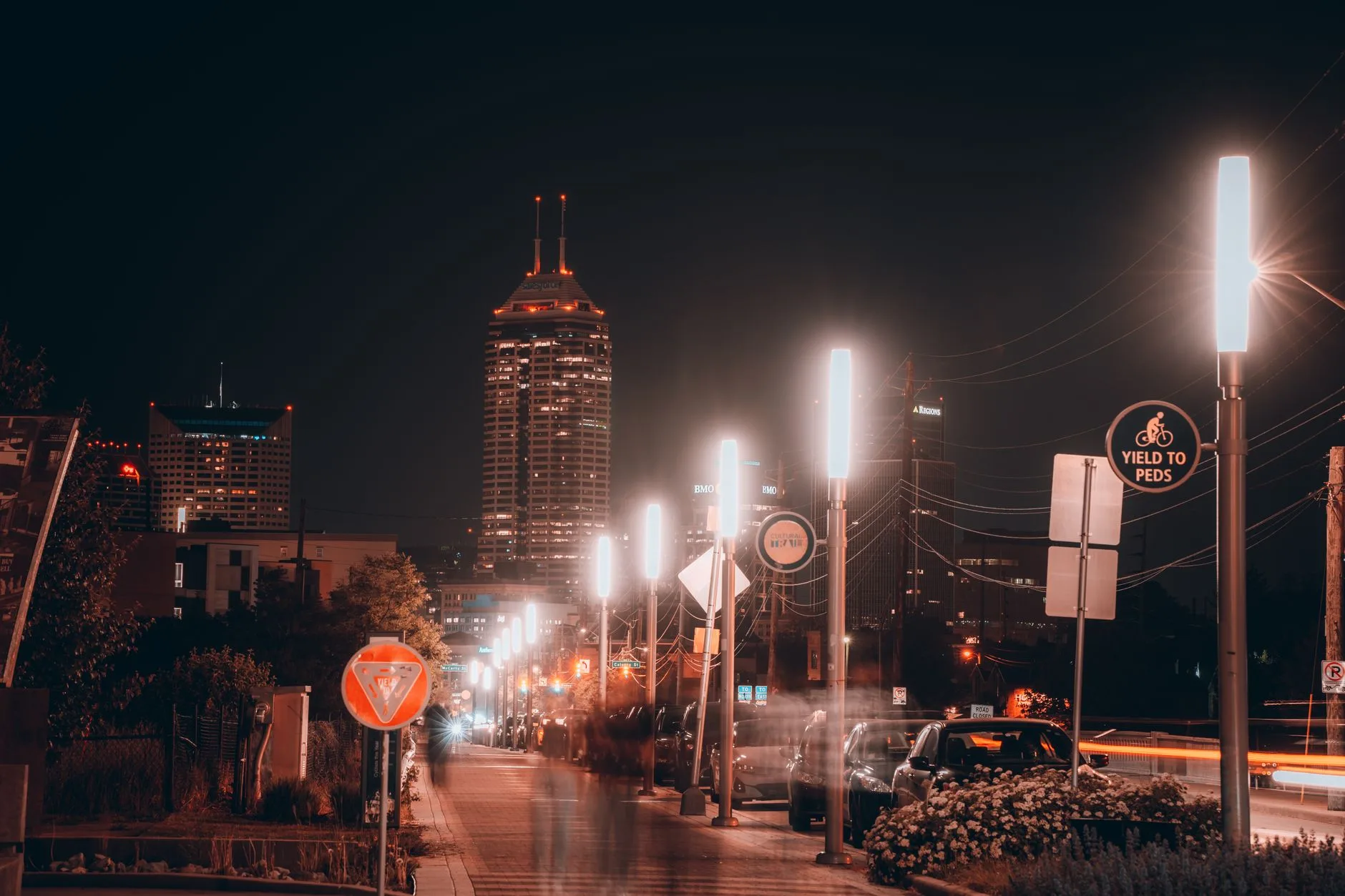
Two vehicular travel lanes, one in each direction, and a multi-use path for the Indianapolis Cultural Trail. The crossing runs between Washington Street and Oliver Street. The city states the purpose on its project pages: connectivity between facilities on each side of the White River, and reduced congestion on Oliver Avenue and Washington Street as the district develops. The Board of Public Works approved the Greenlawn Memorial name, announced on 22 July 2026.
The west-side street package is substantially complete. It rebuilt the D Loop from Washington Street to South White River Parkway, relocated the parkway to meet the D Loop and Oliver Street at Drover Street, extended Innovator Way from Harding Street to the relocated parkway, and connected Holly Avenue. Indy DPW records the funders as the Indiana Economic Development Corporation and the city.
The trail's expansion page adds the wider budget. It lists $49.7 million committed to the entire expansion as of May 2023, including $20 million from Lilly Endowment, $18.2 million from the Indiana Economic Development Corporation, $8 million from the city across the Indiana Avenue, South Street and White River segments, $1.5 million through the Indianapolis Neighborhood Infrastructure Partnership, and $1 million each from the Elevance Health Foundation and the Eli Lilly Foundation.
The disruption the corridor carried
The right of way overlaps Indianapolis's first public cemeteries. The city established the original burying ground in 1821. The project touches 1.359 acres of permanent right of way and 0.601 acres of temporary right of way across the Old Burying Ground and the Union Cemetery. At its fullest extent the burial ground covered more than 25 acres.
Archaeologists excavated 1,709 grave shafts inside the right of way between November 2024 and October 2025, per WISH-TV, and the remains went to an Indiana University Indianapolis laboratory. The reburial plan is still in draft. The city does not anticipate an individual count until osteological research finishes. The Section 106 process closed with a Memorandum of Agreement executed on 3 November 2022 between the U.S. Army Corps of Engineers Louisville District, the Indiana State Historic Preservation Officer and Indy DPW.
Two planned additions around the site came off the books. Indianapolis Business Journal reported on 8 October 2025 that White River State Park returned a $30 million crane bay grant to Lilly Endowment, and on 11 March 2026 that the state abandoned the $65 million White River State Park expansion.
The connectivity evidence that exists
The trail carries its own return figures. Indianapolis Cultural Trail Inc. released a report on 3 June 2026, with analysis by JLP+D, that records $3 billion in added assessed property value along the trail against the $63 million initial investment in its first eight miles. The same report records retail space up 39 percent, food and beverage sales at nearly double the city average per square foot, population along the trail growing at five times the city average, more than one million users a year, and 47 percent of downtown residents within a three-minute walk.
The lodging assets sit at the convention end. Visit Indy counts 12 hotels and 5,200 rooms connected into the Indiana Convention Center and more than 10,000 rooms within walking distance. The convention center's facility guide records 4,721 hotel rooms connected by skywalk and 7,175 rooms within a six-block radius. The west bank carries no published room count.
The numbers that would settle it
Five figures would answer the question.
Average daily vehicle crossings on the deck, with peak-hour delay readings on Oliver Avenue and Washington Street, taken before the opening and again after it.
Trail counts on the multi-use path once the extension opens.
The district's employment total and payroll, with the share of those trips that cross the river.
Room nights and average daily rate attributable to the district's employers. No publisher carries a room-night or rate effect for this corridor, so the request sits with the hoteliers and Visit Indy.
The final split of project cost across the city, the Indiana Economic Development Corporation and private philanthropy.
The city publishes monthly construction reports for this project. Publishing the crossing's trip data after the opening would complete the record.