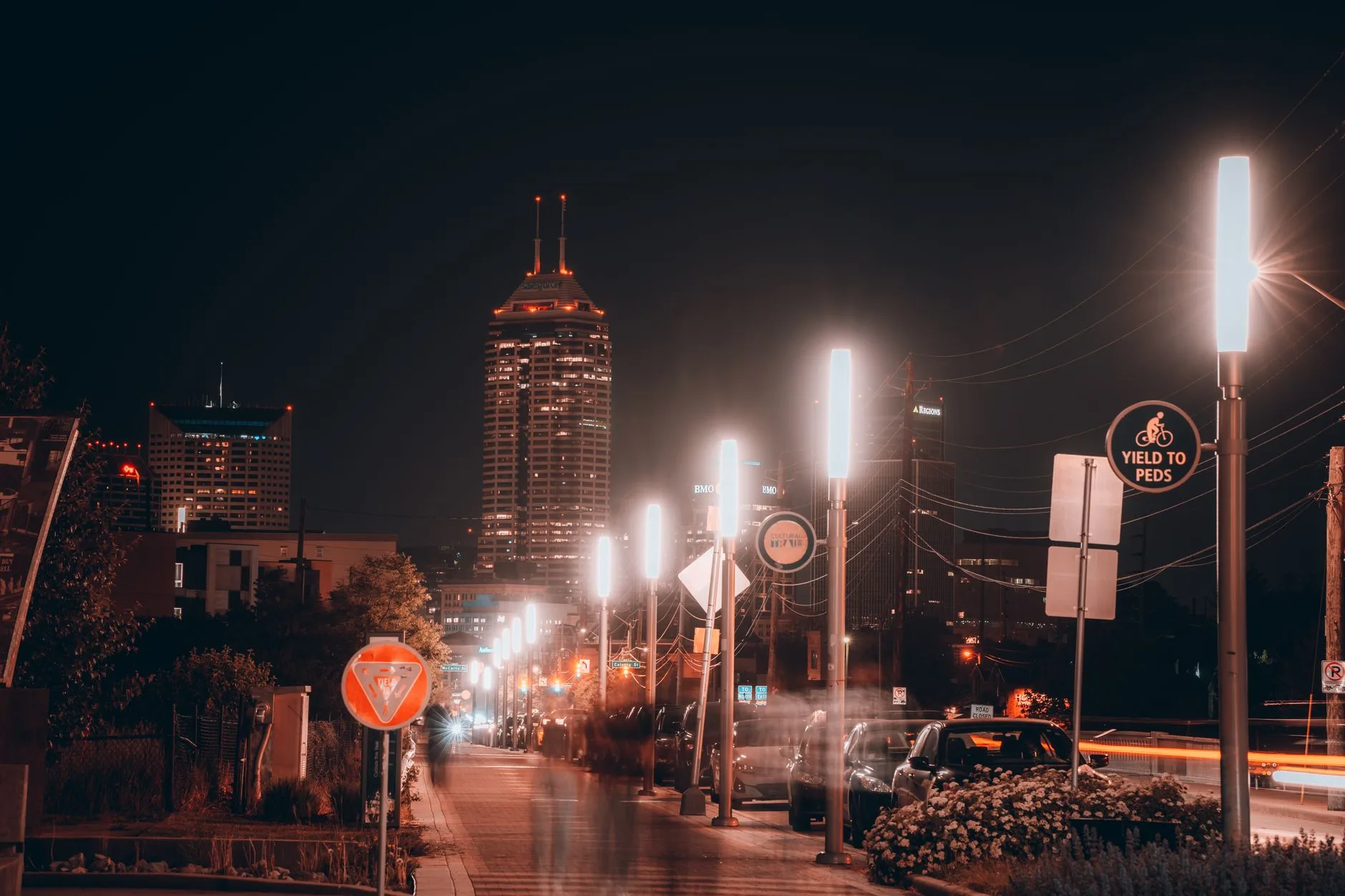
Indianapolis has committed $21.2 million to carry its Cultural Trail across the White River. The trail's own twenty-year impact report does not use the word hotel. It counts assessed property value, retail square footage and food-and-beverage sales. It reports no room nights, no occupancy and no average daily rate.
The defensible position sits between the two claims. Trail spending in Indianapolis belongs in the civic-amenity column, and it carries a hospitality option that no publisher has priced. Three assumptions decide whether that changes.
What the report counts
The report, Indianapolis Cultural Trail: A Legacy of Gene and Marilyn Glick At 20, was released on 3 June 2026 and rests on analysis by JLP+D. It states $3 billion in additional assessed value along the trail since 2008, against the $63 million that built the first eight miles. Trail-adjacent property values grew at more than twice the rate of Indianapolis property values overall. Adjacent parcels carry a median value of $102.90 per square foot against $17.43 citywide, which the report reads as six times the city average.
Retail space beside the trail grew 39 percent since 2008, against 9 percent citywide. Food and beverage sales along the trail run at nearly double the city average per square foot. The residential population near the trail grew at five times the city average. Undeveloped land along the route could add another $1.4 billion in value, the report states.
The report's one use of the word hospitality sits inside that retail sentence. It calls the trail a hospitality booster and supports the phrase with retail square footage and restaurant sales. That is the whole of the hotel-adjacent evidence the sponsor publishes.
Three more figures come from the same report. More than 1 million people use the trail each year. Pacers Bikeshare operates 57 stations around the clock. Nearly half of downtown Indianapolis sits within a three-minute walk of the trail.
What the expansion buys
The White River segment adds about a mile along South Street, Kentucky Avenue and Henry Street, and crosses the river on a new bridge south of Washington Street. The trail's funding table splits the segment's $21.2 million between $18.2 million from the Indiana Economic Development Corporation and $3 million from the City of Indianapolis. The trail's own announcement of 9 May 2023 timed construction to begin in late 2025.
The bridge now carries a name and a schedule. The Board of Public Works voted in July 2026 to call it Greenlawn Memorial Bridge, after the cemeteries the site held from the 1800s. The $40 million structure opens in early 2027 and connects Elanco Animal Health's headquarters in White River State Park to downtown. Archaeologists excavated 1,709 grave shafts at the site, and the full excavation added $12 million and a year to the programme.
Construction procurement is moving. The Board of Public Works awarded a public-private partnership agreement under IC 5-23 to C.H. Garmong & Son on 12 August 2026 for project GT-31-002, Kentucky Avenue to South Street. The construction estimate at 60 percent plans is about $15 million.
The demand curve the trail does not appear in
Indianapolis recorded 8.1 million room nights in the twelve months to mid-2025, more than 580,000 above the market's pre-COVID peak, according to CoStar data relayed in a Bradford Allen market report published on 19 March 2026. The same report puts the pipeline at more than 1,500 rooms under construction, 3,402 in final planning and 3,220 proposed.
A Downtown Indy Alliance snapshot citing CoStar and STR puts downtown occupancy at 64.7 percent against 62.4 percent nationally, RevPAR at $135.20, up 13 percent year over year and 35 percent above the national $99.96, and average daily rate at $209.11, up 12 percent and 30 percent above the national figure.
That demand attaches to the convention district. Visit Indy counts 13 properties and 5,500 rooms in the connected package once the current building work completes, and the Indiana Convention Center's facility guide counts 4,721 rooms connected to the Center with 7,175 within a six-block radius. Visit Indy lists the coming rooms on the same district: Signia by Hilton Indianapolis at 803 rooms in December 2026, a Motto at 116 rooms and a Kimpton at 167 rooms, a Westin at Indianapolis International Airport for December 2027, and a 176-room Ritz-Carlton on Georgia Street.
The west bank where the trail lands carries the Elanco headquarters, which opened on 1 October 2025 at a cost of more than $200 million and houses more than 725 Indianapolis-area employees. The trail's own expansion page names the Elanco campus and the Indy Eleven campus as the destinations the new mile connects.
Three assumptions to test
The first is that the trail study measures visits. It measures value. Assessed value rises for reasons that include land assembly, interest rates and the convention district's own programme. Ask whether a room-night or rate series exists for properties inside a published radius of the trail across the 2007 to 2024 window.
The second is that the trail caused the hotel supply. Indianapolis dates its downtown pipeline to convention and arena demand. Ask whether any developer names the trail in a financing document, a rezoning application or a hotel prospectus.
The third is that downtown performance belongs to one asset. The $135.20 RevPAR is a market number. Ask what share of it comes from trail-adjacent properties.
Two series would settle it
A room-night and average-daily-rate series for a defined corridor within a stated walking distance of the trail, running from before 2007, would show whether hotel revenue moved with construction. A dated, named count of hotel openings inside the same radius would show whether the trail precedes supply or follows it.
Until those exist, trail spending builds a walkable district that hotels can rent, and no publisher shows the rent. The trail's sponsors make their case on property, retail, restaurants and population. The hotel case remains a forecast.